1. What first drew you to playing guitar, and how has that relationship with music evolved over the years?
There was always music in the house. My mom studied viola through college, and played in a few orchestras. My dad was a guitar hobbyist, and played Chet Atkins-style things on his acoustic. There were lots of classical albums at home, plus a bunch of Chet Atkins, Jim Croce, John Denver, and folk stuff from that period, being the late 60s and early 70s.
I started really focusing on listening for guitar when I heard music. I had a Partridge Family plastic guitar during kindergarten. A few years later, my folks put me in private recorder lessons, and that got me thinking about notes, I suppose. On the way home from one of those lessons, I announced that I wanted to switch to guitar and take lessons. My parents made it happen, for which I'm so thankful. I got an acoustic and started lessons with an old guy named Clyde Meadows. He was pretty old at that point, and taught me melodies like "Five Foot Two," and the theme from "Bonanza." Got me thinking about reading music a bit more, but I was really into KISS, Aerosmith, Kansas, Queen, Zeppelin etc. at the time, and just wanted to start playing electric guitar. I took lessons for a few more years with three or four different teachers. During that time, I'd try to figure out my favorite riffs on my own, while trying to focus on the stuff the teachers were giving me. At that point, I still didn't have any actual rock guitar instruction, because none of those instructors would ever ask what I liked. So, it was always "Satin Doll" or other charts for tunes I'd never heard. One guy did start teaching me scales and jazz chords back then, though, which I loved learning. I did lessons from when I was 10 through 13 years old, before just going at it on my own; finding books on chords and scales, learning more and more tunes off the records. When I was 12, I got my first electric. It had been my dad's in the 50s. His uncle made it for him out of mahogany. He wound the pickups himself on a record player, fretted it and everything. It's funny, it was a VERY slim solid body with deep cutaways and 24 frets, almost like a 90s Ibanez maybe. It sounded terrible and shocked me (no KISS pun) when I tried playing it at gigs (other kids' birthday parties in middle school) with the band I'd joined. That guitar was replaced by a Harmony Les Paul copy, which also sounded kind of janky. Then, during the summer before 8th grade, my folks surprised me with a Les Paul. Amazing. I don't think they would've been able to afford one, but a music store was going out of business and clearing out their stock. I still have it.
Anyway, I got into Rush when I hit high school, and things moved pretty fast after that. Rush led to Yes, Genesis, King Crimson and those groups. Meanwhile the guys I was playing with at that point got me into Mahavishnu, Steve Morse, Dregs, Return to Forever, Holdsworth; it was the early 80s, and modern electric guitar was exploding all over the place. Eric Johnson bootleg tapes made the rounds before Tones was released. I was floored by Yngwie's playing on that live Alcatrazz album, too.
I got more and more serious about musical discovery and development, and that really hasn't changed that much over the years. I'm always working on it. I've always practiced a bunch, and get antsy if I haven't made time to play during the day. I keep guitars hooked up to little practice amps in different parts of the house, so I can always just reach over and play something when I feel like it.
2. What made you choose a Rocca guitar, hand-built, headless guitar, made in the U.S.A., over other options you were considering?
Before 2017, I'd never owned a headless, but I got curious. I started off with something less expensive, but after a year I could tell there was something to that general design, so I got a nicer one. I met you, Pablo, the next year in 2019. After trying out the Rocca Models 1 and 3, which you had brought along to a gig I was doing in Houston, I was immediately impressed by the feel and tone, smooth and natural. The next year, I was ready to get another headless, and the Rocca 2 seemed like the perfect thing. I hadn't played one, but based on how the other two models had played and sounded, I took a leap of faith and had one built.
3. Describe the moment you first played your Rocca guitar, hand-built, headless guitar, made in the U.S.A.. What did you notice first — the sound, the feel, something else?
Before I started getting into headless instruments, I had mostly been into Strats, my Les Paul, a couple 60s SGs along with a few others here and there. Mostly Strats, I think. There's something about the range of tones, especially the sweet punch you get when you switch from the bridge to a Strat's neck pickup during a solo. That range and sonic reward doesn't really happen for me so much on Gibsons, though. Not in the same way. I found that the Rocca has a Strat-like voice, and that throwing on the neck pickup mid-solo has that smooth punchiness. It's VERY resonant, even up and down the neck. When you can feel notes resonate under your fretting hand, you know you've got a really well-made instrument.
4. Which Rocca model do you own, and what's your favorite detail about how it's built?
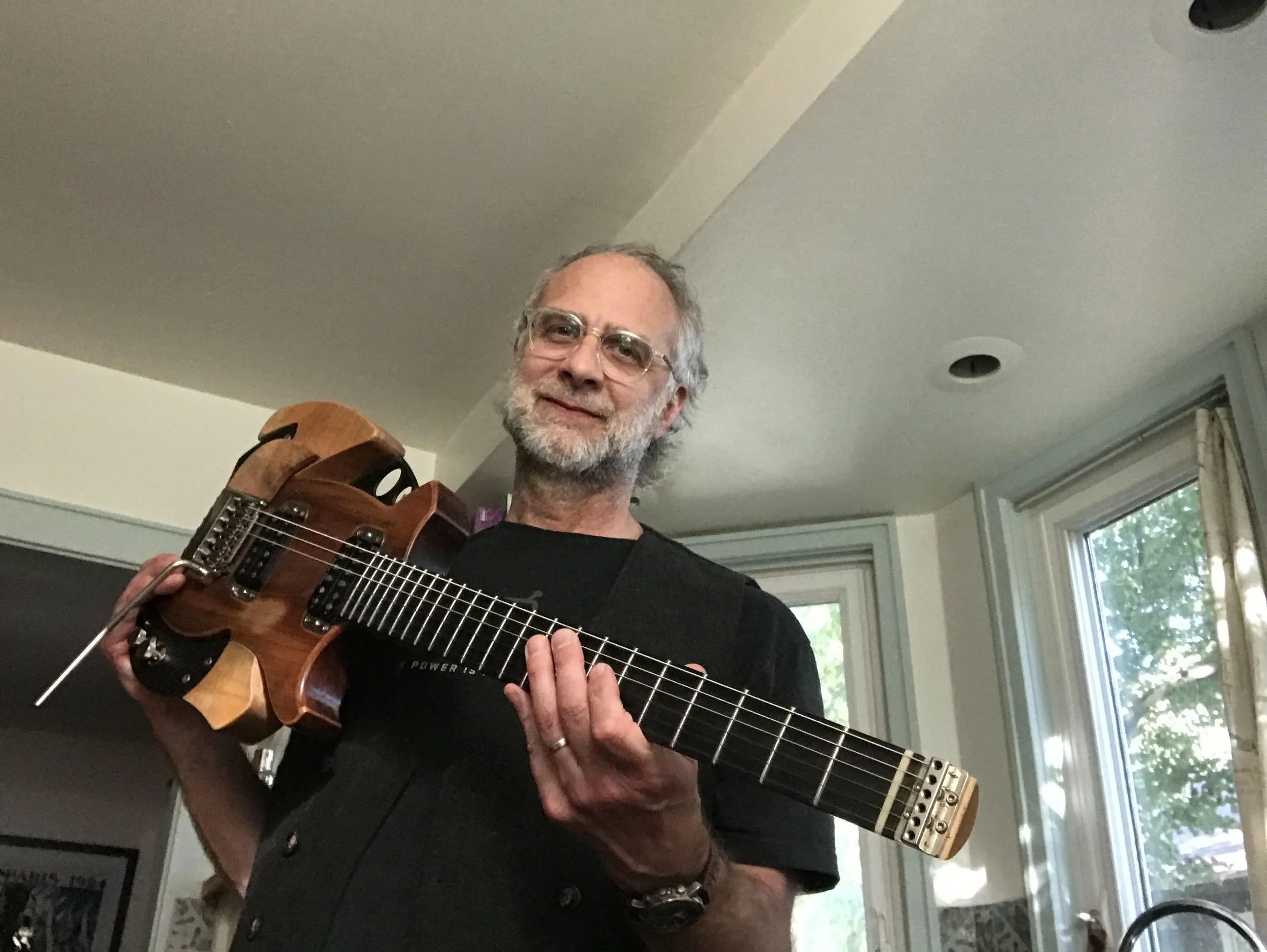
I have the Rocca 2. Some people at a recent gig called it a Picasso guitar. Actually, one guy said, "That's an M.C. Escher guitar!" and another guy suggested it looked more like a Picasso.
I love its voice. It's full-throated while being very dynamic and responsive to touch. It has a broader and maybe more dynamic range than my other guitars. The pickups and their placement play a big part.
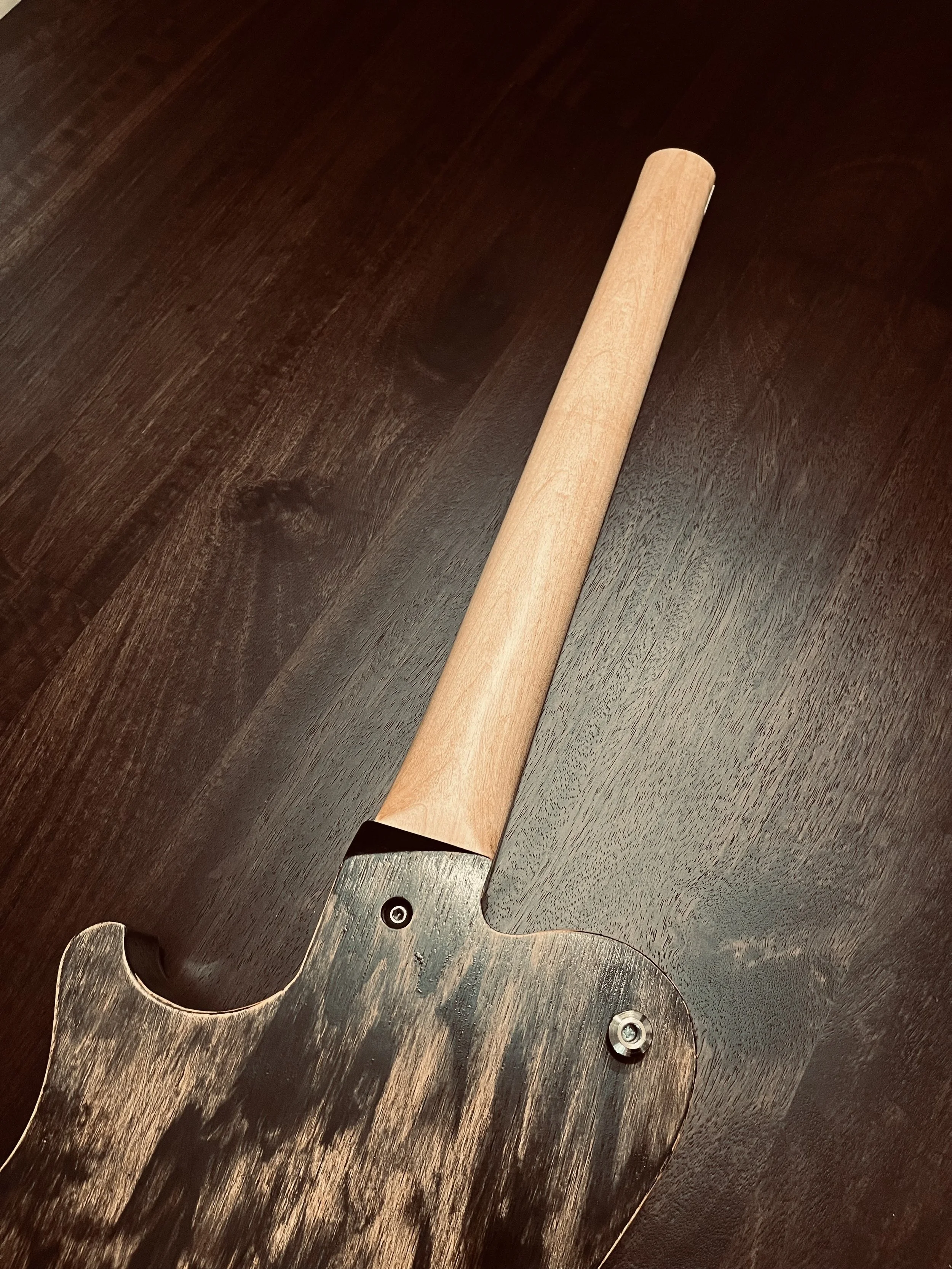
I'd have to say that the neck is my favorite feature. It's perfectly shaped. A fat C with an almost flat ebony fingerboard. I absolutely love this neck. The guitar is perfectly balanced, and feels so natural and comfortable standing up or playing seated.
5. How would you describe the sound of your Rocca guitar, hand-built, headless guitar, made in the U.S.A. to someone who's never heard one?
I would say that it has the most soulful-feeling elements of a Gibson, due to the sonic qualities of the 24.75" scale and the flatter fingerboard radius, paired with the brighter, airier presence of a Strat. I opted to have the bridge pickup moved slightly back toward the bridge on my Model 2. Plus, I have only one coil of the neck humbucker hooked up, so the distance between the pickups combined with that single-coil in the neck position are very natural and familiar feeling to me.
6. Is there a song, riff, or piece of music that feels like “your song” on this guitar?
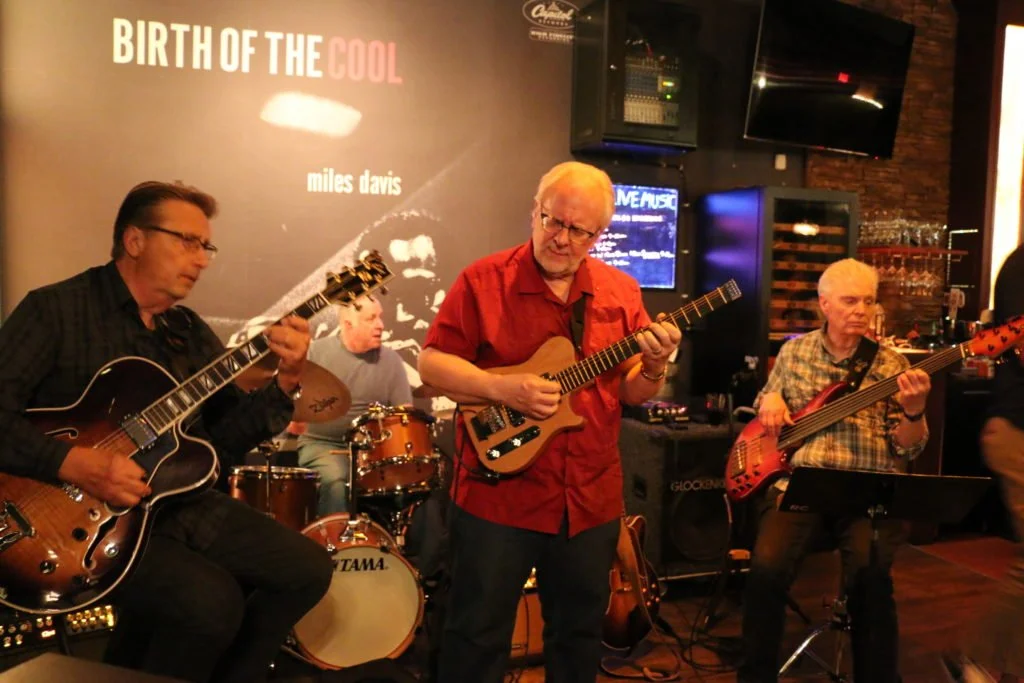
A song or riff? Actually, improvising with a warm, smooth overdrive with some nice natural ambience (along with some electronic help), using altered tonalities; loud enough to fill the space I'm in, is my favorite thing to do on my Rocca. I've used it at many gigs over the last five years. It has felt at home and natural doing "outside" free improv gigs, rock/R&B/country/reggae cover gigs. I've recorded with it for a couple projects, too.
7. Tell us about a memorable moment you've had with your Rocca guitar, hand-built, headless guitar, made in the U.S.A. — on stage, in the studio, or just at home.
There have been memorable moments with the Rocca, for sure. I was really in the zone with it at a couple recent gigs here in Fort Collins. Also, the very first gig with it was in Fort Worth at the Grackle Art Gallery in September of 2021. I played with Eddie Dunlap on drums, Mark Cook on Warr Guitar, Chris White on flute and trumpet, and Canyon Kafer on bass. We did a couple improv sets, and that was what really cemented my relationship with my Rocca.
I've logged lots of hours on it over the last five and a half years.
8. What's changed in how you play or write music since getting your Rocca guitar, hand-built, headless guitar, made in the U.S.A.?
I've started doing more hybrid picking on it, as it seems to respond really well to technical subtleties.
9. If a friend were shopping for their first (or next) guitar, what would you tell them to look and listen for?
I'd recommend that they feel for resonance throughout the guitar, including up and down the neck. Listen for its voice. Is that what you want to hear? Do you keep noticing the physical details of the instrument, or does it allow you to just forget about the instrument you're playing and be creative?
How does it sound loud, and not just at living room volume? Does it feel stable? Is it in tune with itself?
10. What surprised you most about owning a Rocca guitar, hand-built, headless guitar, made in the U.S.A.?
I'd say the resonance in the neck and the full voice of it were the most surprising.
11. Where do you see your music going next, and what role will this guitar play in that journey?
I'm always trying to make my playing more and more effortless, while playing things that kind of swoop around in contour and tonality; sounding natural, while not drawing attention to the technique. Being able to use 8- and 9-note scales more naturally in improv and writing is something I'm working on.
The Rocca is conducive to exploration and creativity.
12. What's one word or phrase that captures what your Rocca guitar means, hand-built, headless guitar, made in the U.S.A. to you?
It sounds and feels personal.
Thank you Bill! You are an AMAZING guitar player!
Check Bill Pohl playing hir Rocca headless guitar model 2! With one of his bands in the following reddit link: